by AUFA MARDHIAH
SMD Semiconductor Sdn Bhd will begin integrating its keteq.GaN power semiconductor technology with China’s Linyang Energy Group in 2027 as the Sarawak company moves its locally developed chip closer to commercial applications.
SMD CEO Shariman Jamil said the integration would involve the keteq.GaN gallium nitride (GaN) power semiconductor chip, as well as another upcoming chip. The technologies are targeted at applications including battery energy storage systems (BESS), smart meters, solar inverters and data centres.
“Currently, we have an existing memorandum of agreement with Linyang Energy Group, a Tier-1 battery energy storage and smart-meter provider in the world. So, starting next year, we are going to integrate keteq.GaN and our next chip.
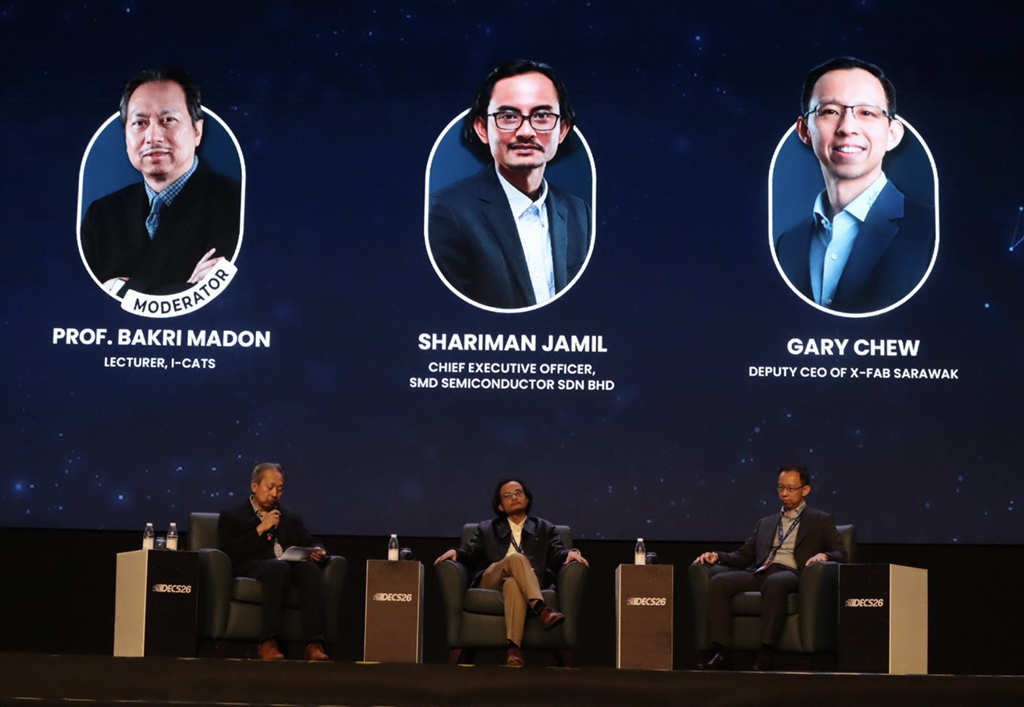
“We will be coming up with a few more chips, but I can’t tell you today. It’s still in the oven cooking,” he said during the Semiconductor Sovereignty and ASEAN Opportunity panel session at the International Digital Economy Conference Sarawak (IDECS) 2026 today.
The 2027 integration will mark the next step for keteq.GaN following its official unveiling at IDECS on Monday, moving the technology from chip development towards products that can eventually be deployed commercially.
But SMD is not looking only at applications within Sarawak.
Shariman said the company’s longer-term target is the global market, with keteq.GaN designed for BESS, smart meters, power-conversion systems and solar inverters. These applications increasingly require more efficient power devices that can operate within smaller and denser systems.
Getting there will involve working with international partners alongside local agencies and the government.
Under the approach outlined during the session, SMD’s chip solutions would be integrated into products developed with international partners and initially deployed locally. Those applications could then be used to demonstrate the technology to potential users across ASEAN.
“If we are able to show that our products, our technology GaN, our keteq.GaN can be showcased in the ASEAN market, that’s where we will fly,” Shariman said.
The company is starting with a relatively small target as it works its way into the global market.
Shariman quoted the global smart-meter market at about US11 billion (RM46.2 billion) this year, while the battery energy-storage market stood at about US30 billion (RM126 billion).
SMD is initially aiming for 0.01% of the opportunity, using partnerships and local deployments as a route towards larger markets.
Beyond energy systems, another potential market is emerging from the rapid expansion of AI data centres.
The company’s computing racks require increasingly dense power systems, creating demand for semiconductor devices capable of handling greater power within a smaller footprint.
SMD is positioning its GaN technology for that requirement. Its latest 650-volt GaN transistor, unveiled on Monday, can handle a load equivalent to six one-horsepower household air-conditioning units, according to Shariman.
The company expects its next generation of chips to serve several of these markets, spanning BESS, solar inverters, smart meters and data centres.
The strategy also reflects a broader effort by SMD to move beyond Malaysia’s established strengths in semiconductor manufacturing and capture higher-value parts of the global supply chain.
Its focus on power semiconductors is centred on markets where the company believes Sarawak has room to build locally owned technology and compete internationally.
Shariman cited a 2022 McKinsey projection that the global semiconductor market could reach US$1 trillion by 2030, identifying industrial electronics and AI, data computing and storage as areas SMD could target.
That opportunity helped steer SMD towards gallium nitride technology as it looks to develop locally owned semiconductor intellectual property for higher-value segments of the global supply chain.
Following keteq.GaN’s unveiling at IDECS 2026, the next step will be to bring the chip into real-world applications through the planned integration with Linyang next year.
The partnership will provide a pathway for the Sarawak-developed technology to be tested in commercial products before SMD looks to expand its reach across ASEAN and other global markets.