
By Sarawakku Team
KUCHING, 15 September 2026 — Sarawak is stepping up efforts to develop homegrown semiconductor technologies and chip designs as it accelerates its economic transformation towards technology, innovation and high-value industries.
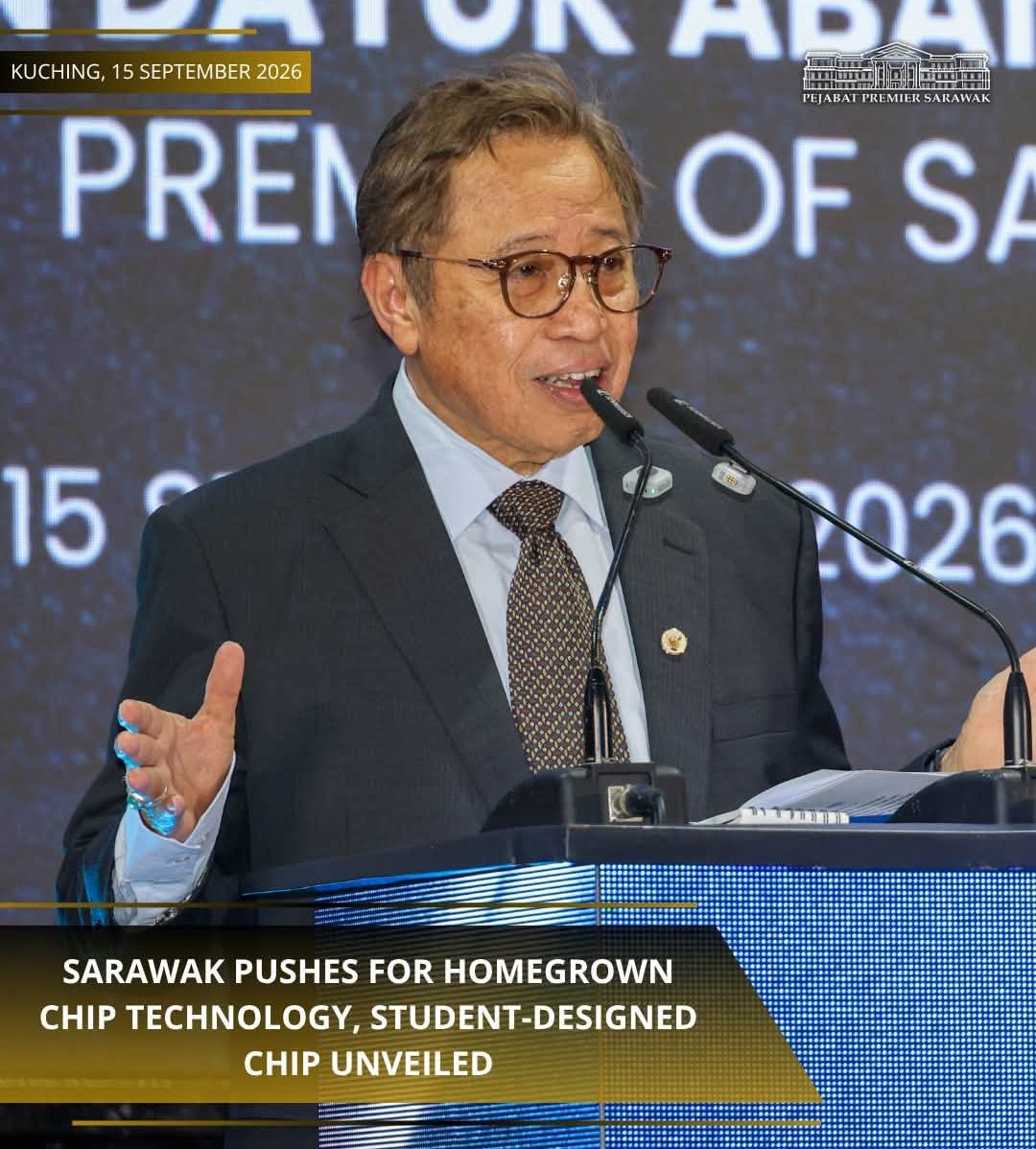
Premier Sarawak Datuk Patinggi Tan Sri (Dr) Abang Abdul Rahman Zohari Tun Datuk Abang Haji Openg said the state must move beyond being a user of technology to becoming a creator, owner and producer of technology, particularly in semiconductor chip design.
He said this when officiating the Sarawak Semiconductor Flagship Talent Development Ecosystem Ceremony at CENTEX, Santubong, here today.
The ceremony also saw the unveiling of a chip designed by students through the SMD IC Design Competition 2025 and fabricated at XFab Foundry in Kuching, marking an important milestone in Sarawak’s semiconductor development.
Abang Johari said the student-designed chip demonstrated that Sarawak’s semiconductor strength could begin with young people being given opportunities to design, experiment, solve problems and create.
“What makes this milestone particularly meaningful is that the chip was designed by our students,” he said.
He said the development reflected Sarawak’s longer-term aspiration to build Sarawak-owned semiconductor technologies and products, strengthen local talent and progressively secure greater ownership across the semiconductor value chain.
Abang Johari said Sarawak’s future competitiveness would depend not on how much technology it used, but on its ability to create, own and commercialise technology, with ideas translated into intellectual property, products and applications for global markets.
He said SMD Semiconductor, established in 2022, had progressed into Phase Two of the Sarawak Semiconductor Roadmap 2030 – Beyond Moore’s Law, marking a shift from capability development towards technology development, intellectual property, commercialisation and greater economic value.
“We want to move beyond being users of technology. We want our people to become IC designers, innovators, owners and, eventually, producers of technology,” he said.
Abang Johari said Sarawak’s semiconductor ambitions were also being linked to global industry opportunities, citing SMD’s recent Memorandum of Agreement with Linyang Energy Group, a Shanghai Stock Exchange-listed company and a global player in smart meters and battery energy storage.
He said the partnership demonstrated how local capabilities could be connected with established international industry players, creating opportunities for Sarawakian talent and businesses to move into higher-value activities.
He also welcomed the exploration of a partnership between SMD and Malaysian-based ZETRO in aerospace-related technologies, as well as the establishment of the SMD Industrial Lab at Universiti Malaysia Sarawak (UNIMAS) to strengthen IC design and research capabilities.
The initiatives, he said, would provide postgraduate students and young engineers with greater opportunities to work with industry and develop technologies capable of strengthening Sarawak’s position in the semiconductor value chain.
Abang Johari said the development of local semiconductor and chip design capabilities would extend beyond the semiconductor industry, supporting strategic sectors including artificial intelligence, advanced manufacturing, renewable energy, power electronics, aerospace and satellite technologies.
He said Sarawak was also exploring the development of its own Low Earth Orbit satellite, targeted for launch by 2030, which would enable the state to obtain its own data for future strategic planning and economic activities.
On the wider semiconductor ecosystem, Abang Johari said Malaysia had traditionally focused strongly on the back-end segment of the industry, including chip assembly and related activities, and Sarawak now wanted to contribute to the front end through its own technology, designs and chips.
He said Sarawak’s ambition was to see a chip designed by the people of Sarawak being used globally, including potentially in future satellite and advanced technology applications.
“Let us dream. Our dream today is to have our own chip design, created by Anak Sarawak but used by the world,” he said.
Abang Johari also supported the call to expand the CENTEXS-SMD Semiconductor Mastery Programme nationwide, saying stronger collaboration between the Sarawak Government, Federal Government, institutions, academia and industry was essential to developing Malaysia’s semiconductor ecosystem and preparing young talent for future opportunities.